


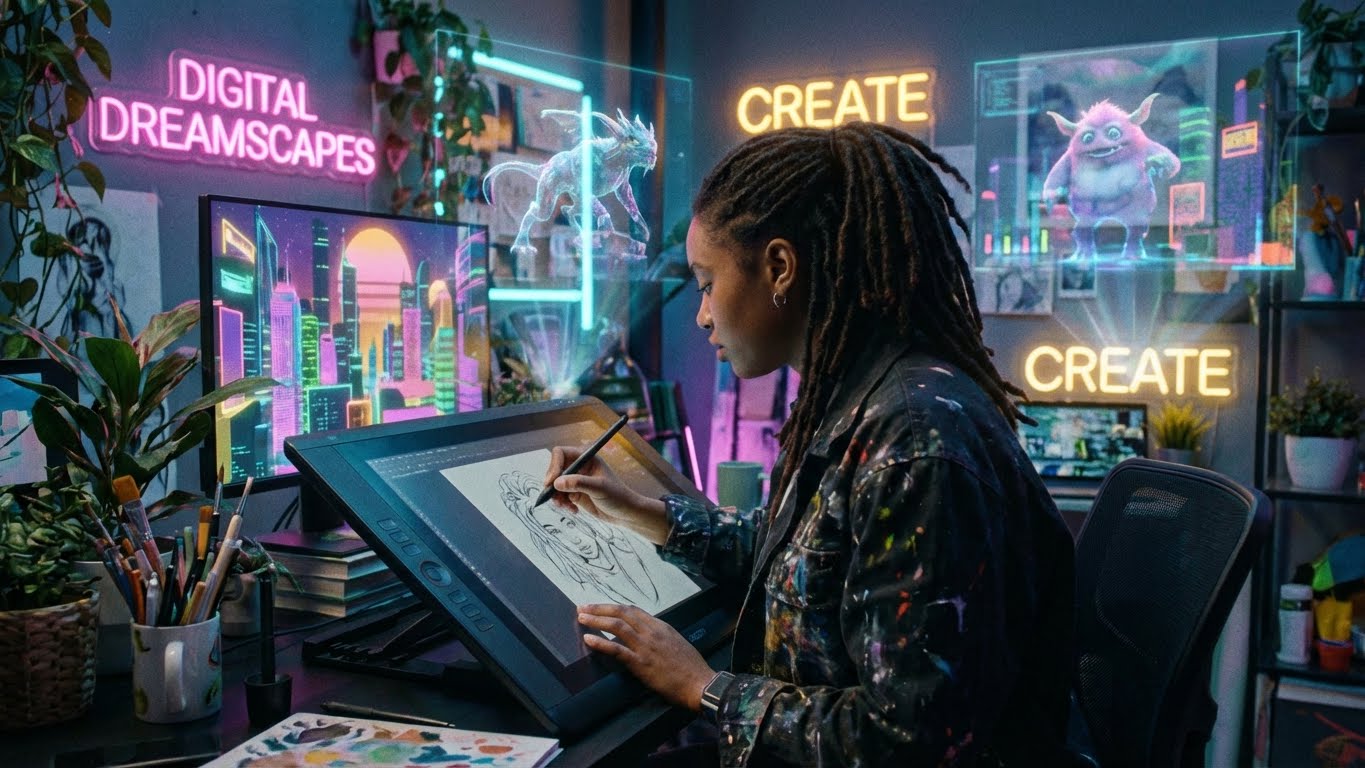
You are living in a moment where the brush meets the algorithm, and the studio extends into the screen. The boundaries that once defined art are dissolving, replaced by a new, infinite canvas. Technology has not only changed how art is created—it has changed how it is experienced, shared, and understood. In this new digital landscape, artists are no longer confined by geography or medium. They are explorers of possibility, shaping a visual language that transcends time, culture, and device.
We believe art is the soul of innovation. It is where creativity meets curiosity, and where tradition merges with transformation. The digital era has opened doors once unimaginable, empowering artists to push beyond the tangible into the immersive. From digital painting and 3D rendering to virtual exhibitions and augmented reality installations, creativity now lives in motion, light, and interactivity. You are witnessing a renaissance—not one of paint and marble, but of pixels and possibility.
Digital tools have democratized creation. With a tablet, stylus, or even a smartphone, artists can bring their visions to life with precision and immediacy. Software platforms now mimic the texture of canvas and pigment, allowing artists to blend traditional techniques with futuristic experimentation. The result is a seamless dialogue between past and present—between the artist’s hand and the machine’s precision. What once took weeks in a studio can now be conceived, refined, and shared in a single day, without losing authenticity.
The expansion of digital platforms has also revolutionized accessibility. Art no longer lives only in museums or galleries; it thrives in global networks of connection. A single post can reach millions, transforming unknown creators into global voices. Social platforms have become virtual salons—places where artists, collectors, and audiences engage in a shared conversation about beauty, identity, and innovation. You no longer have to travel to see extraordinary work; it travels to you. This shift is not about replacing the physical experience of art, but enriching it through expanded reach and inclusion.
Technology has also redefined what it means to “own” art. The rise of digital galleries and blockchain authentication has introduced new forms of collection and commerce. Artists can now sell directly to their audiences, retain creative control, and ensure authenticity through digital certification. This is more than an economic shift—it is a philosophical one. Artists are reclaiming agency, building communities around their work, and redefining value beyond the confines of the traditional market.
Technology allows artists to express complex emotions and ideas in ways that once felt impossible. Virtual reality turns the viewer into a participant, inviting you to step inside the art itself. Artificial intelligence collaborates with human imagination to generate new visual forms. Projection mapping transforms public spaces into living murals that respond to movement and sound. The line between creator and audience blurs as art becomes a shared experience of exploration.
Still, amidst this evolution, the heart of art remains unchanged. Tools may advance, but emotion endures. Behind every digital brushstroke is a human pulse—a desire to connect, to communicate, to make sense of the world. Technology amplifies expression, but it does not replace it. The artist’s vision remains the soul of the work, reminding you that art’s power lies not in its medium but in its message.

The future of visual art will not be defined by one form or platform. It will be a fusion of the tactile and the technological, the classical and the contemporary. The artists who thrive in this era will be those who see technology not as a substitute for creativity but as a companion to it. They will shape a world where innovation serves imagination and where beauty exists both on the wall and in the cloud.
You stand at the edge of a digital revolution in artistry. As you scroll, share, and create, you are part of a cultural movement that redefines what it means to see. Art in the digital era is not just evolving—it is expanding the very boundaries of human expression. And in that expansion lies the brilliance of our time.
